Article 5 Iceland National Pilot 2026
From Ideas to Action The Kaleidoscope National Pilot in Iceland
How do you create educational resources that genuinely reflect the realities of youth work? You build them together with the people who will use them.
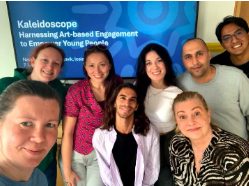
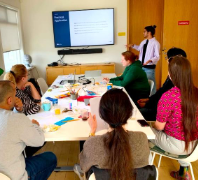
That was the main idea behind the Kaleidoscope National Pilot hosted by ALO Ísland in Iceland, where youth workers and community practitioners came together in Reykjavík for a day of creativity, collaboration and shared learning. The pilot marked an important step in the Kaleidoscope journey, transforming research and ideas into practical experiences while gathering valuable insights that will shape the final Kaleidoscope Arts Toolkit.
Learning by creating
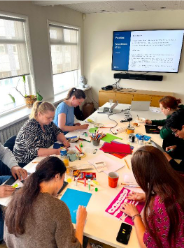
Throughout the day, participants moved through six interactive modules exploring Arts-Based Engagement Ethnography (ABEE), cultural competence, digital arts and technology, trauma-sensitive approaches, inclusion and social integration, and conflict resolution. Each activity invited youth workers to engage creatively through music, poetry, visual arts, theatre and storytelling, encouraging conversations about identity, belonging, participation and community.
The atmosphere was intentionally informal and participatory. Every activity became an opportunity not only to experience the methodology but also to imagine how it could be adapted to their own organisations and the young people they work alongside.
Different perspectives, shared learning
One of the strengths of the National Pilot was the diversity of the group. Participants represented organisations collaborating with ALO Ísland, including the Icelandic Red Cross, Reykjavík Fringe Festival, Community for All and organisations supporting people with disabilities, each bringing different experiences of working with young people and local communities.
That diversity quickly became one of the day’s greatest assets. Conversations naturally moved between different cultural perspectives, professional experiences and creative approaches, demonstrating that there is no single pathway to meaningful youth participation.
Shaping the toolkit together
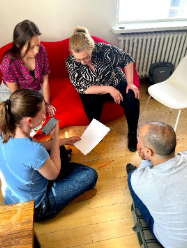
What made the National Pilot in Iceland particularly valuable was that every activity concluded with an open reflection. Participants discussed what felt engaging, what might be challenging for different groups and how activities could become even more accessible and inclusive.
Their feedback went far beyond small adjustments. Participants recommended simplifying language around diversity and inclusion, providing more practical facilitation guidance, incorporating grounding techniques into emotionally sensitive exercises and offering additional conflict de-escalation tools. They also highlighted the importance of flexibility, recognising that activities should be adaptable to different cultural contexts, languages and levels of experience.
More than a pilot
Perhaps the greatest takeaway from the day was the reminder that creativity creates connection.
Whether through music, movement, storytelling or visual expression, youth workers experienced that arts-based methods opened conversations that might otherwise have remained difficult to start. The activities encouraged empathy, curiosity and collaboration while creating space for everyone to contribute in ways that felt natural to them.
These experiences will now feed into the further development of the Kaleidoscope Arts Toolkit alongside the outcomes of the national pilots taking place across the other partner countries.
Looking ahead
By bringing practitioners together to experiment, reflect and learn from one another, Kaleidoscope continues to build a toolkit that is practical, inclusive and adaptable to diverse youth work settings across Europe. The feedback, ideas and creativity shared in Reykjavík will now help shape the final Kaleidoscope Arts Toolkit alongside the experiences gathered across the other partner countries. Together, these contributions will ensure that the toolkit is not only informed by research, but also by the people who will use it every day to support young people in expressing themselves, building connections and finding a sense of belonging.
Funded by the European Union. Views and opinions expressed are however those of the author(s) only and do not necessarily reflect those of the European Union or the OeAD-GmbH. Neither the European Union nor OeAD-GmbH can be held responsible for them. Project No.: 2024-2-AT01-KA220-YOU-
 English
  German
  Greek
Greek  Portuguese
  Icelandic
  Turkish